
About
KLEINBURG HISTORY
Kleinburg began as a milling community in the mid-1800s, growing along the Humber River after German settler John Nicholas Kline built a sawmill and gristmill in 1848. The mills quickly became an important part of the area’s economy, drawing farmers, merchants, and travellers passing between Toronto and Barrie. Over time, more businesses followed, helping shape the village into a small but active commercial centre.
Today, Kleinburg is known for its historic character, independent businesses, and strong connection to Canadian art and culture. Along Islington Avenue, visitors will find boutiques, restaurants, cafés, spas, and specialty shops surrounded by preserved heritage buildings and the natural landscape of the Humber Valley.
The village is also home to the McMichael Canadian Art Collection, which opened in 1966 after Robert and Signe McMichael donated their collection and property to the Province of Ontario. The gallery helped establish Kleinburg as an important destination for Canadian art, attracting visitors from across the country and beyond.
While the community has grown over the years, Kleinburg has held onto the atmosphere that makes it distinct. Whether visiting for a day trip, a meal with friends, a walk through the village, or an afternoon at the gallery, people continue to come here for the same reason they always have: it feels like a place worth slowing down for.
WHAT IS THE KLEINBURG BIA
WHAT IS THE KLIENBURG BIA
The Kleinburg BIA was established in 1984 by local business and property owners in partnership with the City of Vaughan. Today, the BIA is made up of approximately 75 local businesses and 25 commercial property owners within Kleinburg’s commercial core, and remains the only village BIA in the City of Vaughan.
The Kleinburg BIA holds monthly meetings for its members at the Kline House and is administered by a volunteer Executive Board and several committees. Executive positions are elected annually by members. The organization is recognized by the City of Vaughan and undergoes annual financial review by the City’s Finance Department.
The BIA budget is approved annually by both its members and Vaughan Council. Funding comes from fees paid by local businesses and commercial property owners through commercial property taxes collected within the BIA area.
These funds support advertising, beautification initiatives, special events, community promotion, and the continued development of the Kleinburg Village website.
WHAT IS THE KLEINBURG BIA
WHAT IS THE KLIENBURG BIA
The Kleinburg BIA was established in 1984 by local business and property owners in partnership with the City of Vaughan. Today, the BIA is made up of approximately 75 local businesses and 25 commercial property owners within Kleinburg’s commercial core, and remains the only village BIA in the City of Vaughan.
The Kleinburg BIA holds monthly meetings for its members at the Kline House and is administered by a volunteer Executive Board and several committees. Executive positions are elected annually by members. The organization is recognized by the City of Vaughan and undergoes annual financial review by the City’s Finance Department.
The BIA budget is approved annually by both its members and Vaughan Council. Funding comes from fees paid by local businesses and commercial property owners through commercial property taxes collected within the BIA area.
These funds support advertising, beautification initiatives, special events, community promotion, and the continued development of the Kleinburg Village website.
Village Timeline
kleinburg throughout
the years
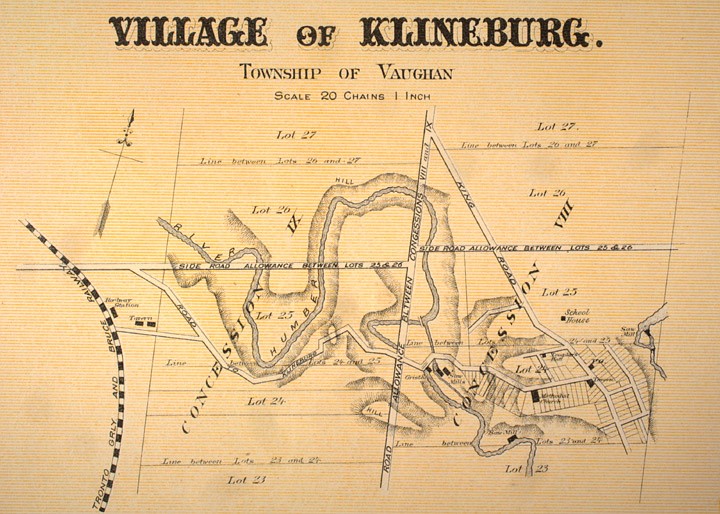
Kleinburg’s history can still be seen throughout the village today. Located between two branches of the Humber River, the community grew from a small milling settlement into one of Vaughan’s most recognizable historic villages. Over the years, Kleinburg became known not only for its local businesses and strong sense of community, but also for its connection to Canadian art and culture through the McMichael Canadian Art Collection.
While the village has continued to grow and evolve, much of its historic character has been carefully preserved, helping Kleinburg maintain the atmosphere that continues to draw visitors from across the GTA and beyond.
Early Settlement
Kleinburg began in 1848 when German settler John Nicholas Kline built a sawmill and gristmill along the Humber River. The mills supported the local farming community and helped establish the village as a growing commercial centre.
In 1852, the mills were purchased by the Howland brothers, including William Pearce Howland, who later became one of the Fathers of Confederation and Lieutenant Governor of Ontario. Under their ownership, the mills became some of the largest between Toronto and Barrie.
Growth of the Community
As Kleinburg continued to grow, the village became home to hotels, tradespeople, shops, churches, and schools. Farmers and merchants travelling to and from Toronto regularly stopped in the community along the Humber Trail route.
During this period, the early roots of the Binder Twine Festival began through annual gatherings organized by local merchant Charles Shaw Jr. What started as a dinner for local farmers eventually grew into one of Kleinburg’s longest-running traditions.
Arts & Culture
The Humber Valley landscape attracted artists including Tom Thomson and members of the Group of Seven. In the 1950s, Robert and Signe McMichael began collecting Canadian artwork at their Kleinburg home, “Tapawingo.”
Their collection later became the McMichael Canadian Art Collection, which officially opened in 1966 and remains one of Canada’s most recognized art galleries.
Kleinburg Today
Although Kleinburg became part of the City of Vaughan in 1970, the village has maintained its distinct identity and historic character. Today, Kleinburg is known for its independent businesses, restaurants, art and cultural attractions, and preserved streetscape along Islington Avenue.
The village continues to attract visitors from across the GTA for shopping, dining, community events, and access to nearby destinations like the McMichael Canadian Art Collection and Kortright Centre for Conservation.
FIND US ON SOCIALS
Join us in the village
Come to Discover the Village of Kleinburg